Self-sabotage trading: Why your best setups fail
You see the signal. You know the plan. Then you do something else entirely. Self-sabotage trading is costing you money—here's why.

Stefan Hertweck
Trading Psychology & KI-gestütztes Journaling
Veröffentlicht: 29. Juni 2026
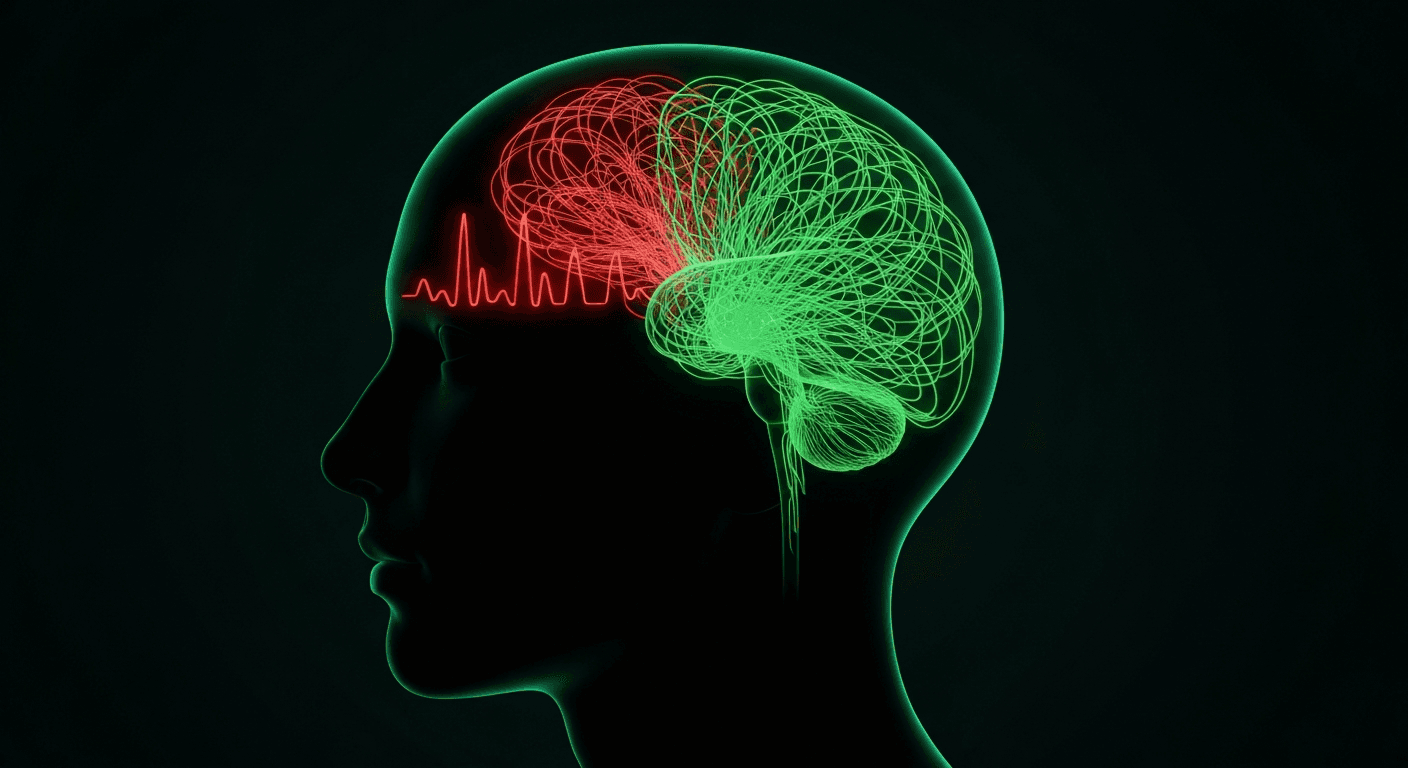
Self-sabotage trading isn't a myth. It's the gap between knowing what to do and actually doing it. You've studied the charts. Your entry is clean. Your risk is defined. Then emotions hijack the decision and you either don't pull the trigger, scale too big, or exit early. This isn't stupidity—it's neuroscience working against you. The amygdala floods your system with stress hormones the moment money is on the line, and your prefrontal cortex (the rational part) gets sidelined. Every trader does this. The ones who win are the ones who recognize it and build systems to counteract it.
The pattern you're probably missing
Self-sabotage trading shows up in predictable ways. You place a winning trade and exit at breakeven because you're afraid of giving back profits. You see a textbook setup but freeze at the buy button. You override your stop loss because you're convinced this time will be different. Or you revenge trade after a loss, ignoring your position size rules entirely.
Research by Barber and Odean ("Trading Is Hazardous to Your Wealth") shows that active retail traders systematically underperform the market. The Dalbar QAIB Report confirms this year after year—investors don't fail because their strategy is broken. They fail because they can't execute it consistently. The data is clear: the trade plan itself usually isn't the problem. Your relationship with following it is.
This is where loss aversion enters. Kahneman and Tversky proved that losses psychologically hurt roughly twice as much as equivalent gains feel good. A $500 loss doesn't feel like the opposite of a $500 win. It feels catastrophic. That asymmetry drives you to break your rules—either by overtrading to recover, or freezing entirely to avoid pain.
Why your brain sabotages your trades
When you're looking at a live position, your amygdala is doing exactly what it evolved to do: protect you from threat. Money triggers a threat response. Your nervous system treats a potential trading loss the same way it treats a predator—with emergency activation. Stress hormones flood in. Your breathing becomes shallow. Your field of vision narrows. You're literally in fight-or-flight mode.
In this state, the executive functions that made your trading plan are offline. You can't think strategically. You can only react. So you exit the trade to reduce the anxiety. Or you add to it because you're in denial. Or you sit frozen, unable to act at all.
This isn't weakness. This is human neurology. The brain region responsible for rational decision-making (prefrontal cortex) literally has less blood flow when financial threat activates the amygdala. You become a different version of yourself at the moment you need your best thinking most.
The second mechanism is confirmation bias layered on top. Once you're in a losing position, your brain actively seeks information that proves you were right. You ignore the data that contradicts your entry. You create a story where the setup wasn't really broken—the timing was just unlucky. This justifies holding when you should cut, feeding the loss.
How to interrupt self-sabotage: The FlowTrader AI approach
You can't override neurology through willpower alone. You need a system that catches you before you sabotage.
FlowTrader AI does this through three interconnected tools. First, emotion tracking forces you to see the exact emotional state you were in before, during, and after every trade. This creates distance between impulse and decision. Instead of being in the emotional storm, you're observing the pattern. Over time, pattern recognition replaces denial.
Second, your AI Coach Flow reviews your trades and highlights the moments where emotion likely hijacked your plan. It's not judgment. It's mirror feedback. You see yourself making the same mistake under the same emotional conditions repeatedly. That's the data you need to build new habits.
Third, the discipline system layers in accountability without adding pressure. You commit to your plan in writing before entering. You see the deviation in real time. Small accountability structures—applied consistently—rewire behavior faster than motivation ever does.
The mindset sessions work because they're specific to your failure patterns, not generic advice. You're not told "control your emotions." You're shown exactly which trades you sabotaged and why, then given micro-practices to handle that specific trigger next time.
What you can start doing today
You don't need to wait for FlowTrader AI to interrupt self-sabotage trading. These moves work immediately:
1. Before you trade, write your exit plan. Not in your head. On screen or paper. Entry price, stop loss, profit target, the exact emotional state where you'll break the plan. This external record becomes your script when emotions spike.
2. Size your positions so a loss feels manageable. If you're terrified, you're sized too big. Reduce position size until a loss feels like "okay, I'll take that." This removes the amygdala activation that drives sabotage.
3. Set a rule: Do not touch the trade for X minutes after entry. Your worst decisions happen in the first 5-10 minutes when adrenaline is highest. Lock yourself out. Use a timer if needed.
4. After every trade, log one fact about your emotional state. Anxious. Confident. Confused. Greedy. This takes 10 seconds but builds awareness. You'll start seeing which emotional states correlate with your worst executions.
5. Review only trades where you deviated from your plan. Ignore the ones you executed cleanly. Deviant trades contain the data about your sabotage patterns. That's where growth happens.
6. Find one small thing you sabotage repeatedly, and commit to ONE attempt to fix it. Not everything at once. One habit. One trade type. One trigger. Master that, then expand.
Stop fighting yourself. Start trading your plan.
Self-sabotage trading is the single biggest leak in retail trader accounts. It's not that your strategy doesn't work. It's that you don't follow it under pressure. Awareness alone won't fix this—you need structure, feedback, and specific accountability tied to your actual trades.
FlowTrader AI is built for exactly this. Track emotion. See patterns. Interrupt sabotage. Build discipline. Not through willpower, but through data and systems.
Start with 7 days free. No credit card required upfront. See your trading patterns clearly. If it's not your tool, cancel anytime. But most traders find that once they see their own sabotage in the data, they can't unsee it—and they can't stay the same.
7 days free · Payment method charged only after trial · Cancel anytime
Frequently asked questions about self-sabotage trading
The main cause is neurology, not lack of knowledge. When money is on the line, your amygdala activates and flood your system with stress hormones. This reduces blood flow to your prefrontal cortex (where rational decisions happen) and you become reactive instead of strategic. You know the plan intellectually, but your nervous system is in threat mode. This is why you freeze, override your stops, or override your entries. It's not stupidity—it's neuroscience working against you under pressure.
You're self-sabotaging if you consistently deviate from your trading plan under emotional pressure. Signs include: exiting winners too early, holding losers too long, entering positions you know violate your rules, oversizing or undersizing based on fear, or sitting out trades that match your setup. The key indicator is the gap between your plan and your execution. Review your last 10 trades—if more than half have deviations, self-sabotage is your primary leak.
No. Willpower is a depleting resource, and it fails exactly when you need it most—when real money is at risk and stress hormones are flooding your system. You can't willpower your way past neurology. You need external systems: pre-written plans, position sizing rules, delayed entry timers, emotion tracking, and accountability structures. FlowTrader AI builds these systems so you're not relying on willpower to execute. Systems win. Willpower loses.
Self-sabotage is execution failure. A bad strategy is design failure. If your strategy is sound but you deviate from it repeatedly under pressure, you have a self-sabotage problem. If you follow your plan consistently and still lose money, your strategy is bad. Test which one you have by tracking deviations. If you execute perfectly on 5 trades and profit, but execute poorly on 15 trades and lose, your strategy works—your execution doesn't. That's sabotage. That's fixable.
No system guarantees anything. What FlowTrader AI does is make self-sabotage visible. You see the exact moment you deviated, the emotion you were in, and the pattern across trades. This visibility drives behavior change faster than any other approach. You'll interrupt sabotage more often, but the goal isn't perfection—it's consistency. Small improvements in execution compound into significant improvements in results over time.
Das könnte dich auch interessieren
Stefan Hertweck
Trading Psychology & KI-gestütztes Journaling
Veröffentlicht: 29. Juni 2026