Prop trading psychology: Why your edge disappears under pressure
You have a winning strategy. Prop firm rules destroy it anyway. Here's what actually happens in your brain when real money is on the line.

Stefan Hertweck
Trading Psychology & KI-gestütztes Journaling
Veröffentlicht: 06. Juli 2026
Prop trading psychology is not about having a better system. It's about what happens to your brain when you're trading someone else's capital with drawdown limits breathing down your neck. Most traders enter prop firms thinking the only variable is skill. They're wrong. The moment you sit down in front of that live account, your nervous system hijacks your decision-making. You know how to trade. You still do it wrong. This article breaks down exactly why—and what to do about it.
The performance cliff: Why prop traders blow accounts faster than retail traders
The data is brutal. Retail traders underperform markets. Prop traders underperform retail traders. Research by Barber and Odean (2000) shows that active traders—even skilled ones—destroy their own returns through behavioral errors. In prop firms, the pressure amplifies this effect tenfold.
Kahneman and Tversky's loss aversion framework explains part of it: a loss hurts roughly twice as much as an equivalent gain feels good. In a prop firm, you're acutely aware of drawdown limits. You see the red in real time. Your brain perceives this as a threat, not an opportunity. Under this threat perception, you make three predictable mistakes: you hold losers too long (hoping to avoid the pain of realization), you cut winners too early (locking in relief), and you overtrade (desperately chasing back losses).
The disposition effect—selling winners too fast and holding losers—destroys prop traders systematically. Add the psychological weight of knowing that failure means losing access to capital, and you're fighting a neural battle, not a market battle. Your amygdala activates. Your prefrontal cortex—the rational part—goes offline. You become reactive instead of systematic.
Why your brain sabotages you in prop firm environments
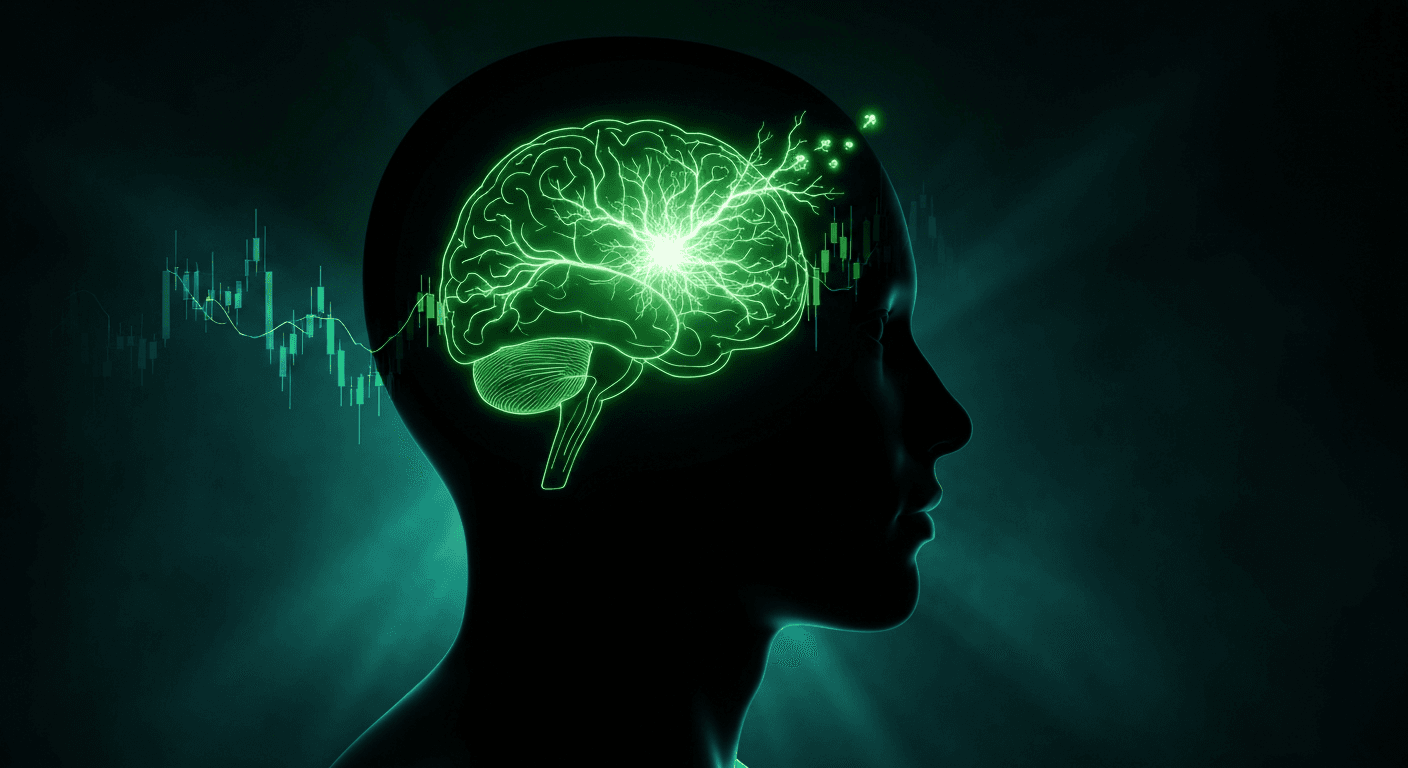
Prop firm trading triggers a specific neuroscience problem. Your brain evolved to avoid loss. When you're trading on a firm's capital with strict risk limits, your threat-detection system (amygdala) stays in overdrive. This activation directly impairs rational decision-making in the prefrontal cortex.
Additionally, prop firms introduce performance pressure that most retail traders never experience. You have monthly evaluations, drawdown rules, and the knowledge that one bad week could end your access. This constant stress keeps cortisol elevated. Elevated cortisol narrows your cognitive bandwidth—you focus on survival, not strategy.
The second problem is psychological ownership. Even though it's not your money, you feel responsible for it. This creates a conflict: you're trying to trade passively and systematically, but your brain is in defensive mode. You second-guess entries. You panic-exit winning trades. You chase losses. Your edge doesn't disappear. Your discipline disappears.
Third, prop trading removes the safety valve of position sizing based on personal risk tolerance. You're forced into standardized risk rules. If those rules don't match your psychological capacity in high-stress moments, you crack. You break your own system because the system itself feels unsafe to your nervous system.
How emotion tracking and AI coaching fix prop trading psychology
FlowTrader AI solves this by doing something traditional trading journals never do: it connects your emotional state to your trading decisions in real time.
Here's what actually works. You log each trade with your emotion before entry and after exit. You rate your discipline level. You note psychological patterns—like whether you're overtrading when anxious or cutting winners when excited. Over 7-10 days, patterns emerge that you can't see alone. You realize you break your system every time you feel down 2% on the month. Or you hold losers specifically after a winning streak (overconfidence reversion).
FlowTrader AI's AI coach—Flow—doesn't tell you "trust the system." Flow reviews your actual behavior and shows you the specific moment where discipline collapsed. It identifies the emotion that preceded the mistake. It builds a personalized discipline system based on your psychology, not a generic rulebook.
The third component is structured mindset sessions. These aren't motivation talks. They're targeted interventions for the specific threats prop traders face: drawdown psychology, performance pressure, and the disposition effect. The system teaches you how to reframe losses as data, not threats. This is not fluffy—it rewires your brain's response to drawdowns.
Result: you stop trading blind. You see yourself. That awareness alone restores discipline.
4 concrete moves to stabilize your prop trading psychology right now
1. Track your pre-trade emotion state every single entry. Rate it 1-10. Within two weeks, you'll see the emotion-mistake connection clearly. Most traders find they make their worst decisions at specific emotion levels (usually high anxiety or false confidence).
2. Set a "drawdown pause threshold." Decide in advance: if you hit -1.5%, you stop trading for 24 hours and review your last 5 trades on video. No exceptions. This breaks the panic-retrading cycle that destroys most prop accounts.
3. Use the disposition effect fix: set exit rules before entry. Write down your profit target and stop loss. Write down when you'll take partial profits. Do this before you enter. During the trade, you follow the rules. Post-trade analysis goes into your emotional journal, not back into live trading.
4. Create a 10-minute decompression protocol after losers. Walk away from the screen. This gives your amygdala time to cool and your prefrontal cortex to come back online. Most traders immediately revenge-trade because their threat system is still activated.
5. Review your trades with only emotion metrics for one week. Don't look at profit or loss. Look only at: Did I follow my rules? What was my emotion state? Where did I deviate and why? This reorients your brain toward discipline instead of outcome obsession.
6. Log your mindset before each trading session, not just individual trades. If you start the day anxious or overconfident, your entire trading approach shifts. Name it. Adjust position sizing down. This prevents systematic error cascades.
The real edge is psychological discipline, not strategy
Prop trading psychology determines who survives and who doesn't. Your edge in markets is real. Your ability to execute it under pressure is the actual bottleneck. FlowTrader AI builds that execution capacity by giving you honest feedback on your behavior, not your balance.
You don't need a better strategy. You need a system that shows you when and why you break your current one. That's what separates prop traders who scale capital from prop traders who blow accounts.
Start with 7 days free. See exactly where your discipline cracks. Then decide.
7 days free · Payment method charged only after trial · Cancel anytime
Frequently asked questions about Prop trading psychology
Prop firm trading adds performance pressure, strict drawdown limits, and the psychological weight of losing access to capital. Your threat-detection system (amygdala) stays activated because the stakes feel permanent. Retail trading lets you trade based on personal risk tolerance. Prop firm trading forces you into standardized rules that may not match your psychological capacity under stress. This is why prop trading psychology is harder—not because prop firms have better markets, but because your nervous system is in constant defensive mode.
Most traders see clear emotional patterns within 7-10 days of consistent logging. You'll notice the specific emotion states that precede your worst trades, the drawdown percentages where you panic, and the winning streaks that trigger overconfidence errors. These patterns are invisible without external tracking. Once visible, you can design rules to interrupt them. Flow's AI coach accelerates this by highlighting patterns you might miss on your own.
No. FlowTrader AI improves execution discipline, not market edge. If your strategy is flawed, emotion tracking won't fix it. However, 80% of prop traders who blow accounts don't fail because their system is bad—they fail because they break their system under pressure. Prop trading psychology training fixes the second problem. You need a baseline edge first.
This is called the disposition effect, and it's hardwired into human loss aversion. Losses hurt twice as much as gains feel good (Kahneman & Tversky). In prop firms, you're acutely aware of drawdowns. Your brain perceives a held loser as a way to avoid the pain of realization. A winner taken early gives you relief. Emotion tracking reveals exactly when this pattern kicks in for you. Once you see it, you can set pre-entry exit rules to override the impulse.
No. No system guarantees anything in trading. What FlowTrader AI does is show you the specific moments where your discipline collapses and why. If you have a real edge and you follow the discipline insights the system uncovers, your odds improve dramatically. The goal is to execute your system consistently, not to make bad systems work. Prop traders who blow accounts usually have the skill but lack the psychological systems to stay disciplined under pressure. That's what FlowTrader AI addresses.
Das könnte dich auch interessieren
Stefan Hertweck
Trading Psychology & KI-gestütztes Journaling
Veröffentlicht: 06. Juli 2026